
Two talks, one message: the tailwinds are gone
Last week I gave two talks to two very different audiences: Swiss family offices at SFORES in Bad Ragaz on 3 November, and ULI Europe's Global Exchange Council in Dublin the day after. On paper the topics had little in common: rates and property for a franc-based investor in one, Ireland's growth model in the other. Yet both decks ended up making the same argument. Much of what carried returns and growth over the past decade came from outside forces, and those forces are changing. You can download them at the end of this post (figures as of early November).
Bad Ragaz: rents will have to do the work
The energy shock has turned the global rate cycle: almost half of the 37 central banks we track have a higher policy rate than six months ago, while a year ago four in five were cutting. Over the three months to October, more than a third of the ca. 600 yield series we monitor moved out and only 4% moved in, and 93.5% of the 279 European prime markets on our MRE Score are priced tight or very tight relative to bonds. With long rates where they are, capital values will likely have to be carried by rental growth, not by falling yields.
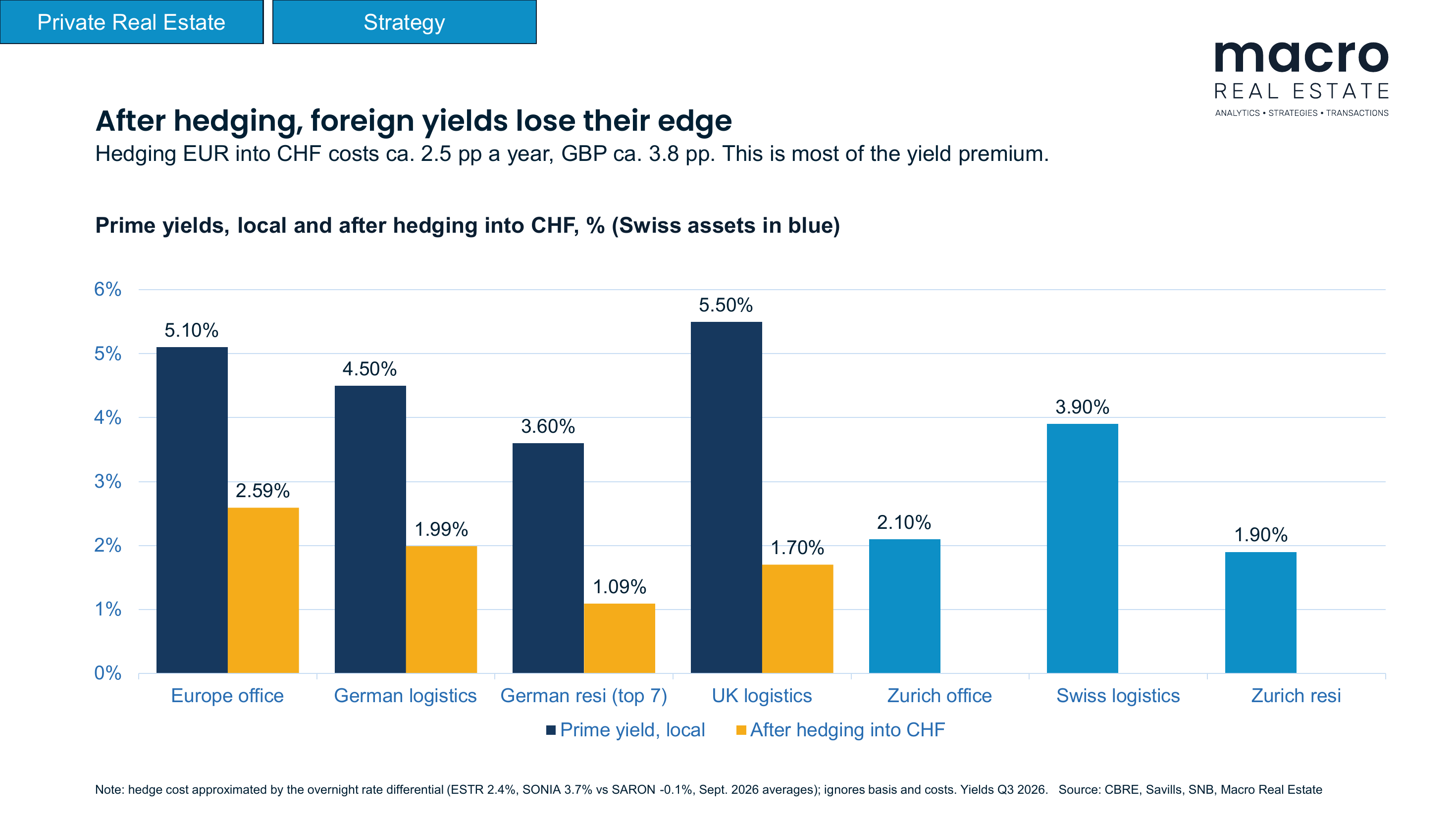
Switzerland is (so far) the exception, with the SNB at 0%, a vacancy rate of 0.9% according to the FSO, and prime yields still edging down. But it is also priced like one: at 2.1%, a 25 bps rise would cost a prime Zurich office more than 10% of its value. Going abroad for yield is less rewarding than it looks. Hedging the currency costs roughly the gap in short-term rates, i.e. ca. 2.5 percentage points a year for the euro (ECB deposit rate at 2.5%) and around 3.8–4.0 for sterling (Bank Rate is now at 4.0%, it was 3.75% when I delivered the talk). German prime logistics at 4.5% (CBRE) thus yields approximately 2.0% once hedged into francs, about half of the 3.9% that Swiss prime logistics offers. The case for going abroad has to rest on growth, in sectors with structural tailwinds that the Swiss market barely offers.
Source: CBRE, Savills, SNB, Macro Real Estate (Bad Ragaz deck, slide 18)
Dublin: Ireland's growth engine runs on outside fuel
Ireland's growth is the output of a system: foreign direct investment brings jobs, exports and tax receipts, which pay for the skills and infrastructure that attract the next investor. Much of the fuel, however, has come from outside Ireland: a US security guarantee, open access to the US market and the freedom to compete on tax rates. The engine is also concentrated, as the ten largest corporate groups paid 59% of net corporation tax receipts in 2025 and foreign-owned multinationals 87%, according to Revenue.
Each of those inputs is now dearer, more conditional or less certain. In 2025, US tariffs reached their highest level since the 1940s, according to the Tax Foundation, a 15% global minimum tax now limits what a low tax rate can achieve, and Europe has to rearm. Today's strong numbers mostly describe yesterday's system, because plants, people and know-how change slowly. The flows change first, and they are moving: Irish goods exports to the US fell by 65.1% in the first half of 2026, partly as last year's stockpiles were run down, according to CSO figures. Of the four traps I see for Ireland, housing worries me most. The Housing Commission puts the deficit at 212,500–256,000 homes, and the political frustration that follows tends to create policy uncertainty, which slows building further. We see this dynamic in Berlin, as an example: lack of housing leads to political frustration which pushes for socialising the stock so private capital stays away. End result: the housing shortage worsens.
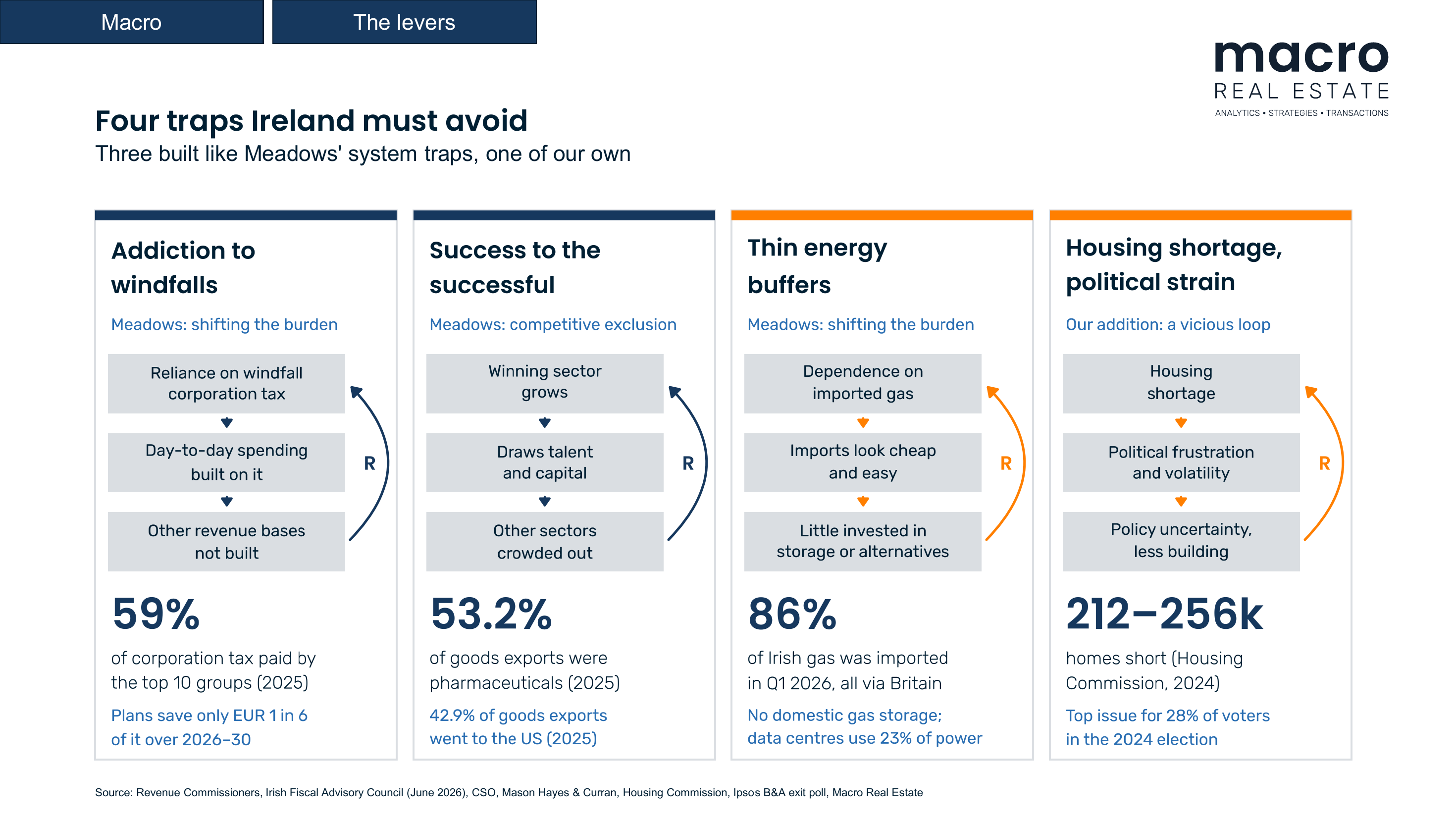
Source: Revenue, Irish Fiscal Advisory Council, CSO, Housing Commission, Macro Real Estate (Dublin deck, slide 9)
Both talks ended with ageing
In Ireland, more than 88% of people over 65 live in under-occupied homes, according to the ESRI. Small, accessible homes near services, combined with equity release for older owners, would free up family homes and ease the housing trap at the same time. In Switzerland, the number of residents aged 80 and over is set to roughly double to more than one million by 2055 in the FSO's reference scenario, which makes senior housing an obvious tailwind sector for a Swiss family office, at home and abroad. It is an operational asset, of course, so the operator matters as much as the building.
What should investors do?
- Underwrite on rental growth. With long rates where they are, the bond market won't do the work for you.
- Decide on the currency before the market: hedged, the return has to come from rents; unhedged, you are betting on the franc not rising further.
- Abroad, take concentrated positions in sectors with demographic tailwinds, e.g. senior housing and logistics.
- Keep a firm eye on the Strait of Hormuz, the French budget and the SNB.
Neither Ireland nor a Swiss family office can stop the world from fracturing, but both can choose where to push.
Download the slides
- Ireland's growth story in a fractured world (ULI Europe Global Exchange Council, Dublin, 4 November 2026, PDF)
- Macro View: Global & Swiss Markets (SFORES, Bad Ragaz, 3 November 2026, PDF)
If you would like us to take your investment committee or board through either deck, feel free to reach out.
Free for members
Read the full article
Our Thoughts are free for registered members. Sign up with your email, or log in if you already have an account.