
Swiss inflation is back where it was in late 2021. Should real estate worry?

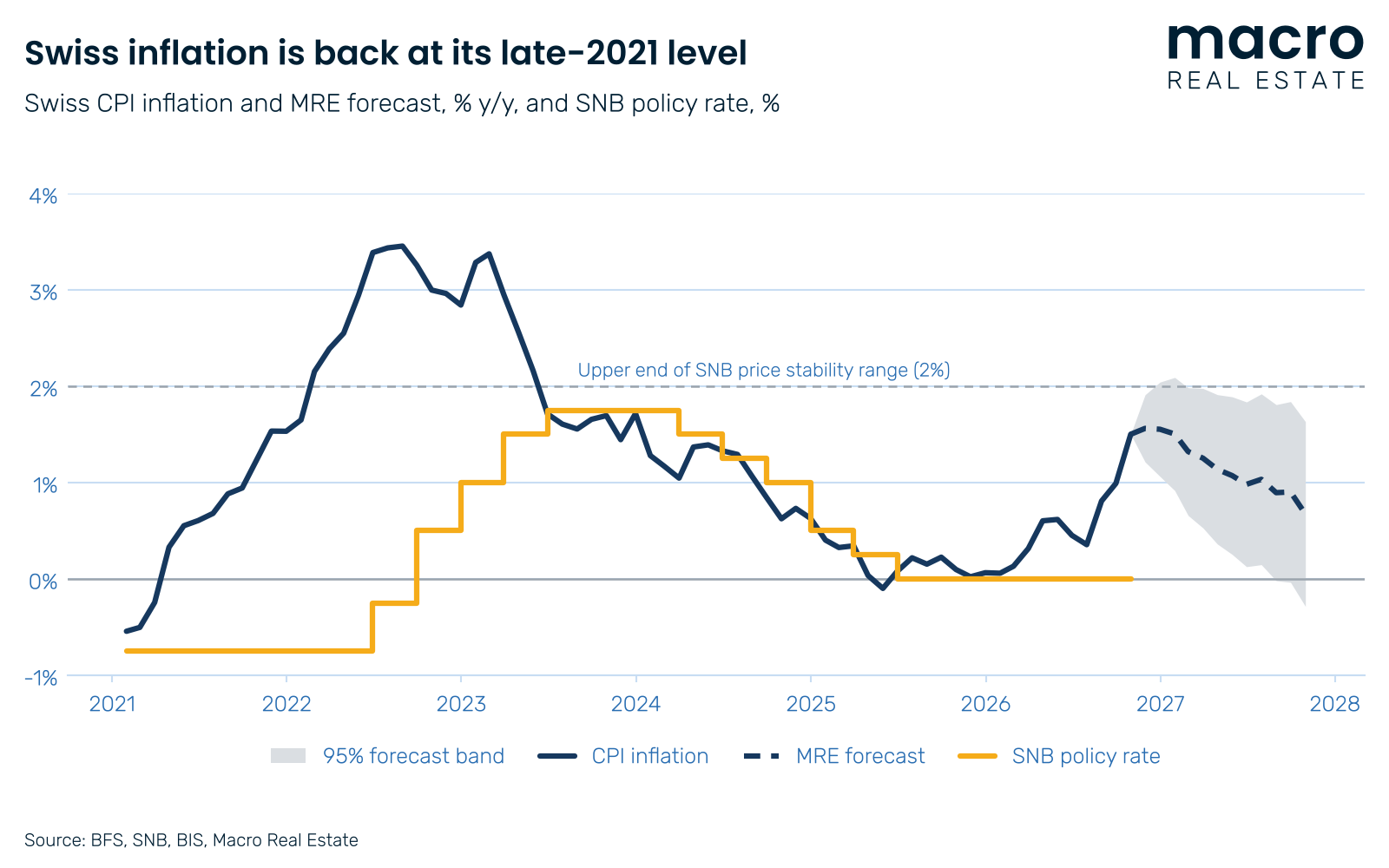
Swiss consumer prices rose by 1.5% in the year to October, up from 1.0% in September and the highest rate in nearly three years, according to the Federal Statistical Office. That is still inside the Swiss National Bank's 0–2% range, and most would not call it alarming. But it is exactly where Swiss inflation stood in November 2021, a few months before it broke through 2% and pushed the SNB into its first rate hike in almost 15 years. The question for real estate investors is therefore a simple one: could it happen again, and how well is the Swiss property market prepared if it does?
What happened in 2022, and what is different now?
The 2022 episode is worth recalling because it shows how quickly things can turn. Swiss inflation was 1.5% in November 2021, rose above 2% in February 2022 and peaked at 3.5% in August 2022, according to SNB data. The SNB had held its policy rate at −0.75% since 2015 and, with inflation at 2.9% in May 2022, it raised the rate by 50 bps in June 2022, followed by four further increases that took it to 1.75% by June 2023. For real estate the consequences followed with a lag: the mortgage reference rate, which had never been raised since its introduction in 2008, rose to 1.50% in June 2023 and 1.75% in December 2023, giving landlords the right, provided earlier cuts had been passed on, to raise existing rents by up to 3% each time. The 10-year Swiss bond rate also rose, reaching almost 1.6% at the end of December 2022, from ca. −0.5% two years earlier, according to SNB data.
Today's starting point looks similar on the surface. Energy is again the driver: oil products and heating fuel pushed up prices in October, and our own breakdown shows housing, energy and transport accounting for 1.2 percentage points of the 1.5% headline rate. There are important differences, however. The SNB starts from 0.00% rather than −0.75%, and core inflation is far lower: the BFS core measure, which excludes energy, fuel and fresh and seasonal products, rose only 0.5% over the year to October, according to the BFS release, whereas in 2022 core inflation climbed steadily towards 2%. The franc has also been firmer recently, with EUR/CHF at 0.92 at the end of October, against 0.95 at the end of September according to SNB data, which takes some pressure off import prices.
Source: BFS, SNB, BIS, Macro Real Estate
What would it take for the SNB to raise rates?
Our forecast model sees inflation at around 1.6% in November and December, before it eases to roughly 0.7% by October 2027 as the energy base effects drop out. That is above the SNB's conditional forecast from September, which saw inflation at 1.2% in the fourth quarter of this year and an average of 0.8% in 2027, assuming a policy rate of 0.00%. Our component model, which forecasts 11 groups of the basket separately, is more pessimistic still and peaks at around 1.7% in January 2027. The upper end of our 95% forecast band touches 2.1% around the turn of the year. Our base case is therefore that inflation peaks in the coming months, but the risks are tilted upwards.
For the SNB to raise rates, in our view, several things would likely need to happen at once. First, energy prices would need to stay high long enough for diesel and freight costs to work their way through producer prices into the prices of other goods and services, which is the cost-push channel that turned an energy shock into broader inflation in 2022. Second, core inflation would need to move clearly towards 1.5–2%, which would signal second-round effects through wages and services. Third, the franc would need to weaken again, as it did over the summer, so that imported inflation adds to domestic pressure. Finally, the SNB's own conditional forecast would need to rise above 2% within its horizon. Even then, the SNB has said it is willing to be active in the foreign exchange market, and selling foreign currency to strengthen the franc could partly substitute for rate hikes, as FX sales complemented the hikes from mid-2022 according to the SNB's Annual Report 2022.
The last few days have, if anything, made the hiking scenario less likely. The Democrats are set to control both chambers of Congress after the US midterm elections, and markets appear to read the result as raising the odds of a push towards a negotiated end to the war with Iran. Brent oil is now trading around USD 97 a barrel, according to Trading Economics, which takes it below its level at the start of October. Should that hold, lower oil prices would feed through to Swiss headline inflation via fuel and heating oil within months.
That is a big if, however: US strikes on Iranian territory continued last week, and Iran's supreme leader has reportedly warned that anyone expecting a change in US policy is "gravely mistaken", as The National reports.
Swiss property is priced for rates to stay at zero
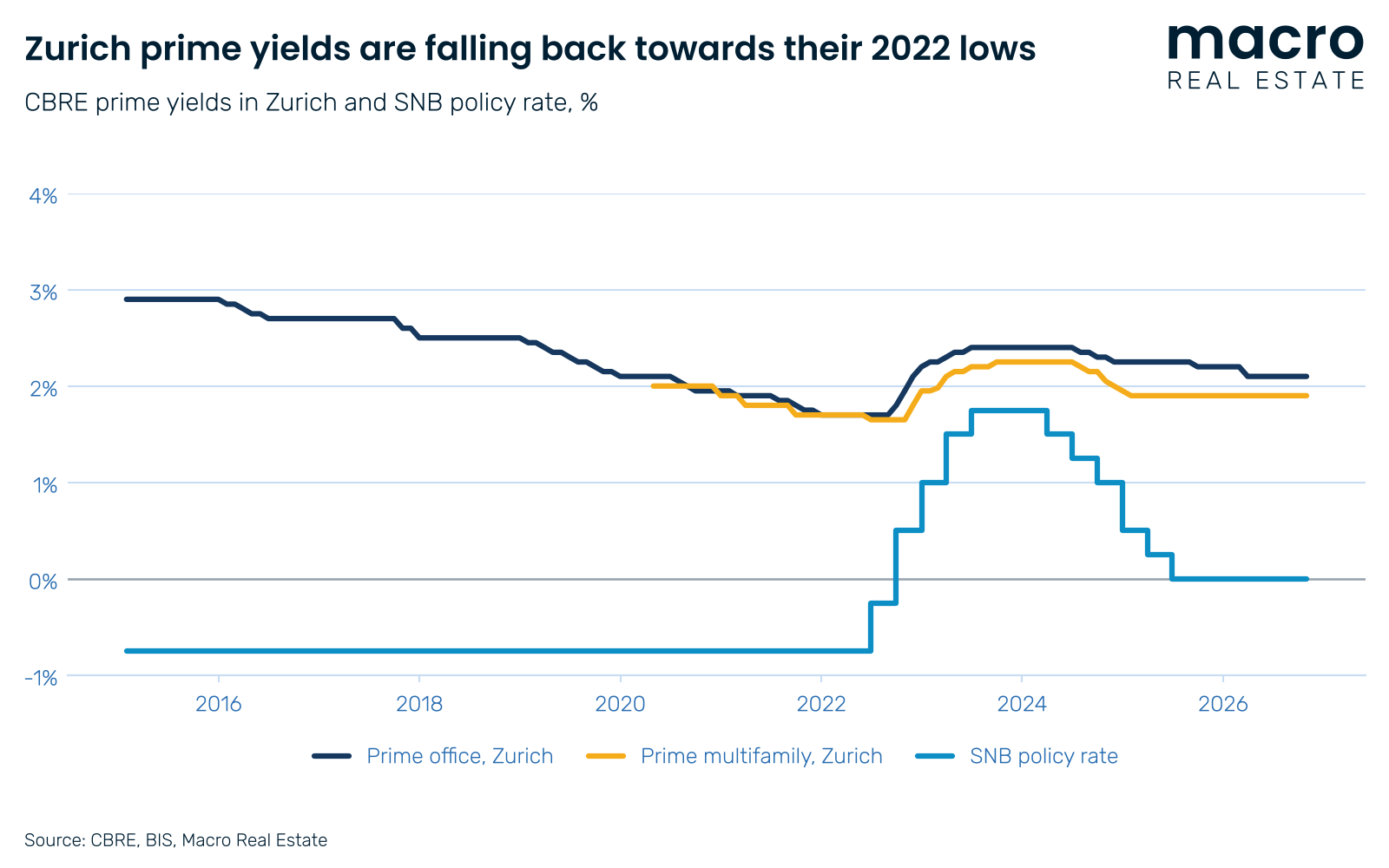
This is where real estate investors should tread carefully. Valuations have, recently, been rising faster than rents, largely on the back of cheap money. The IAZI investment property price index rose by 4.5% in the year to Q3 2026, while IAZI's offered rent index rose by 2.3%, down from around 3.5% in the first half of the year. CBRE puts prime Zurich multifamily yields at 1.90% and prime Zurich office yields at 2.10%. After the 2022–23 hikes, those yields rose from 1.65% and 1.70% to peaks of 2.25% and 2.40%, and they have since retraced more than half of that rise in multifamily and just over 40% in offices.
Rental income, meanwhile, has limited room to grow. The mortgage reference rate is 1.25%, and the underlying average mortgage rate of 1.31% would need to rise above 1.37% for it to increase, according to the Federal Office for Housing. With SARON at around zero, that is unlikely in the near term. That leaves inflation as the main lever for existing leases, and here tenancy law is restrictive: unless a lease is explicitly indexed, landlords may pass on at most 40% of the rise in consumer prices, i.e. ca. 0.6% at today's inflation rate. Market rents are not much help either. Wüest Partner expects asking rents to rise by 0.9% across Switzerland in 2027, and in the city of Zurich asking rents have already fallen by 1.7%, which according to Wüest Partner could indicate that many households have reached the limit of what they can afford, as reported by cash.ch.
Let's take a simple example. A prime Zurich apartment building valued at a 1.90% yield would lose 15.6% of its value, at unchanged rents, if yields returned to their 2023 level of 2.25%. With existing rents growing at around 0.6% a year through inflation pass-through, it would take almost three decades of indexation to make up for that, and longer still if inflation falls back as we expect. A market that leaves so little room for error is, in short, priced to perfection.

Source: IAZI, Macro Real Estate
Source: CBRE, BIS, Macro Real Estate
What should investors and real estate teams do?
Our base case is that Swiss inflation peaks around the turn of the year and the SNB holds at 0.00%. But the asymmetry is unfavourable: little upside from rents and a lot of downside if rates move. We would therefore suggest the following:
- Stress-test valuations against a 25–50 bps rise in exit yields and check loan-to-value covenants against it. The 2022–23 move in Zurich prime yields was 60–70 bps.
- Apply the CPI pass-through to existing leases systematically and document it. At 40% of inflation it is small, but in a market where rental growth is otherwise capped, every adjustment counts.
- Do not underwrite acquisitions on further yield compression or on Zurich market rent growth. The recent fall in asking rents in the city of Zurich is a reminder that affordability sets a ceiling, however scarce the flats.
- Review your financing mix. SARON-based debt is cheap today, but it leaves the borrower fully exposed to a rate hike. Fixing part of the debt while rates are low may be worth the cost.
- Keep a firm eye on core inflation, producer prices and EUR/CHF as well as the headline rate, on the SNB's December assessment and the next reference rate publication on 1 December.
And remember: it is easier to prepare for higher rates when they are a risk than when they are a fact.
Free for members
Read the full article
Our Thoughts are free for registered members. Sign up with your email, or log in if you already have an account.