
Prospects for Swiss real estate investors in the “post-COVID era”

Overheated premiums at fund level and Japan-style conditions reminiscent of the 1980s in the direct market shape the current picture for new investment in Swiss residential real estate. Given a changed global macroeconomic environment, we see an urgent need for action. Real estate portfolios should be analysed for vulnerabilities and oriented more strongly towards net income growth. This may mean more “commercial” or “value-add” investment in Switzerland. Swiss investors’ persistently low allocations to foreign real estate are untapped potential, as that is where such opportunities are to be found in greater number.
Japan in the late 1980s does not bring back good memories for real estate investors. The fall in net yields to below 1.5% for central prime office assets marked the peak of “the mother of all real estate bubbles” at the time. A lost decade followed. By 1998, net yields in the Tokyo office market were back above 5%. Purely as a result of the change in capitalisation rates, this implies a valuation loss of more than 70%.
Since then, until recently, yield levels this low were not to be found in any real estate market worldwide. For residential properties in central locations in Zurich, however, investors today are prepared to pay prices that correspond to net initial yields below 1.3%; such is the desperation to find suitable income-producing properties.
The market for indirect Swiss real estate investments is also crowded. The weighted premium of the Swiss real estate fund index stood at 42.5% at the end of 2021 (Source: CSAM calculations). Residential real estate funds are even trading at premiums of more than 50%, i.e. investors are prepared to pay 50% more than the latest underlying valuation of the portfolio.
Premiums are correlated with interest rate levels
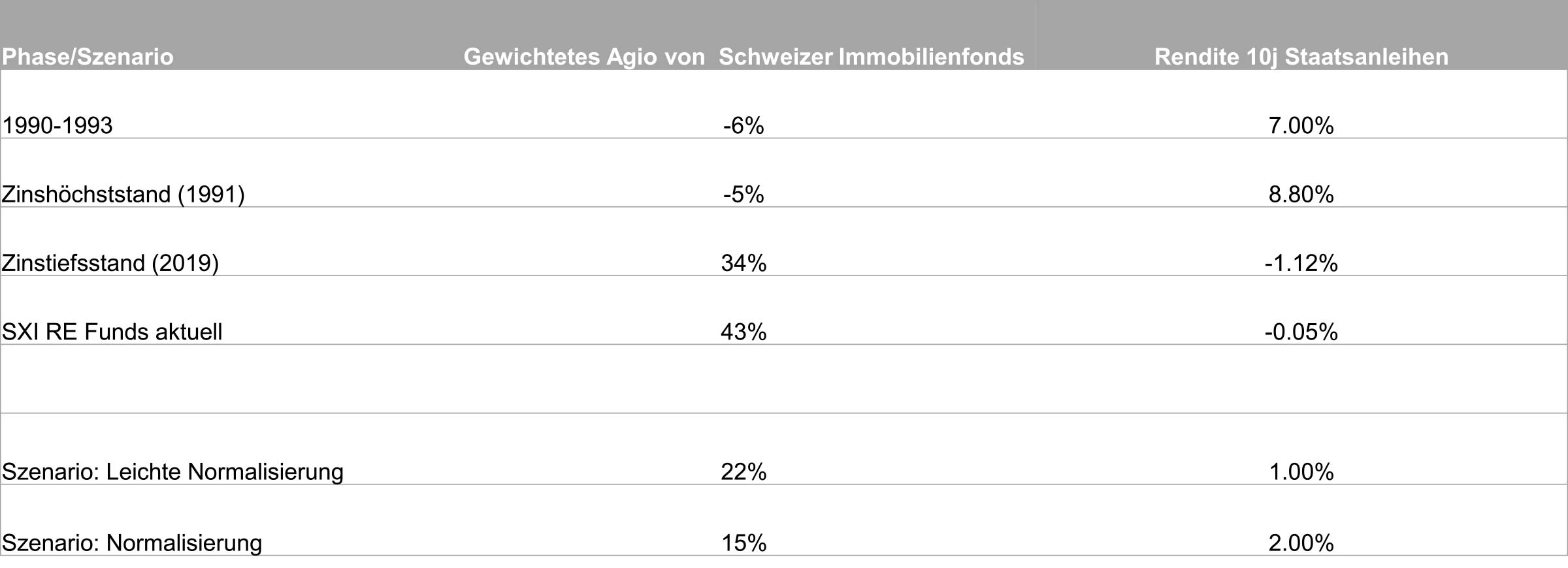
The historical time series, compiled by CSAM’s analytically excellent RE Business Development team and reaching back to the early 1990s, show that premiums are strongly correlated with interest rate levels. Between 1990 and 1993, Swiss real estate funds traded on average predominantly at a discount, and 10-year government bond yields were between 5% and 8% at the time.
We have summarised some key figures in the following table. Despite the rise in long-term interest rates over the past few quarters, however, premiums have continued to rise.
The fundamental question for investors is which way things will go. Yet if 10-year government bond yields were to normalise only slightly, to 1%, we assume that average premiums would have to fall by more than 20%.
Table 1: Premiums on Swiss real estate funds and interest rates
Source: CSAM, Macro Real Estate
The 2020s: structurally higher global inflation could bring a turn in interest rates
In retrospect, however, it has paid off for Swiss investors to bet on the Swiss real estate market. Swiss real estate funds have delivered a total return of 6.5% a year since Q1 2002, with annualised volatility of 5.9%. Swiss real estate investment foundations (NAV-based vehicles) offered even better risk compensation over the same period. Their return was 5.1% p.a., with volatility of just 0.7% a year. These are very robust results over a long period of 20 years.
Continued confidence in Swiss real estate investments, residential in particular, therefore rests on the one hand on their value stability in the past. On the other hand, at such premiums the market is still implicitly pricing in that there will be no turn in interest rates in Switzerland, and therefore none in the eurozone either, for the foreseeable future. The indirect real estate market is thus going even further than the fixed income market, which has seen 10-year yields move up by more than 50 basis points over the past twelve months. Anyone buying the market at today’s premium levels is therefore implicitly agreeing that the global inflation environment over the next few years will not differ significantly from that of the past 15 years. But how realistic is such an assumption?
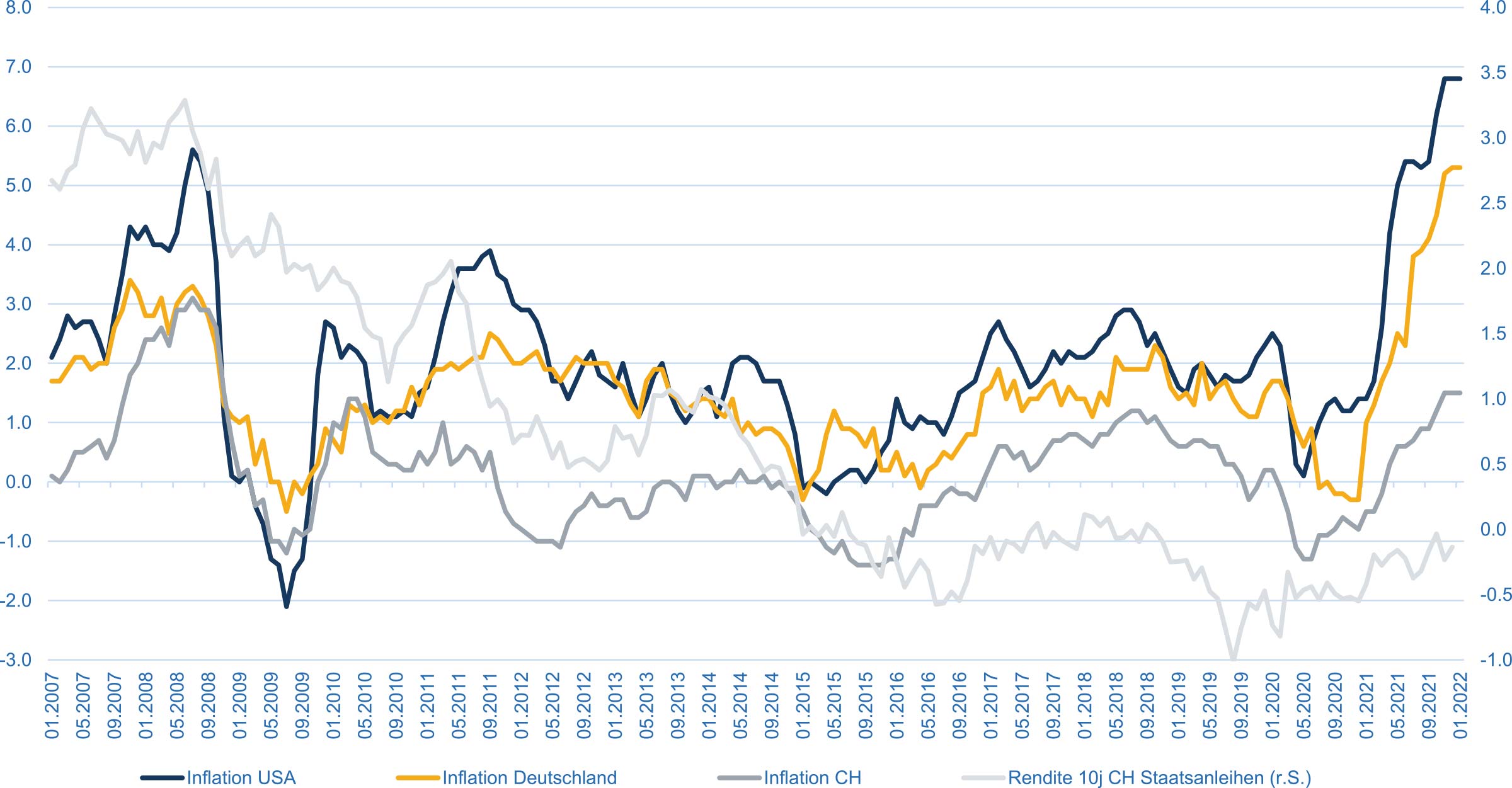
As Figure 1 shows, inflation in Switzerland remains subdued, even though it has reached its highest level since 2010. Germany and the US saw a sharp rise in the second half of 2021, to the point that even the US Federal Reserve no longer regards it as “transitory” and the US market already expects 75 bps of rate hikes in 2022.
Figure 1: Inflation and interest rate trends
Source: Macro Real Estate, Bloomberg
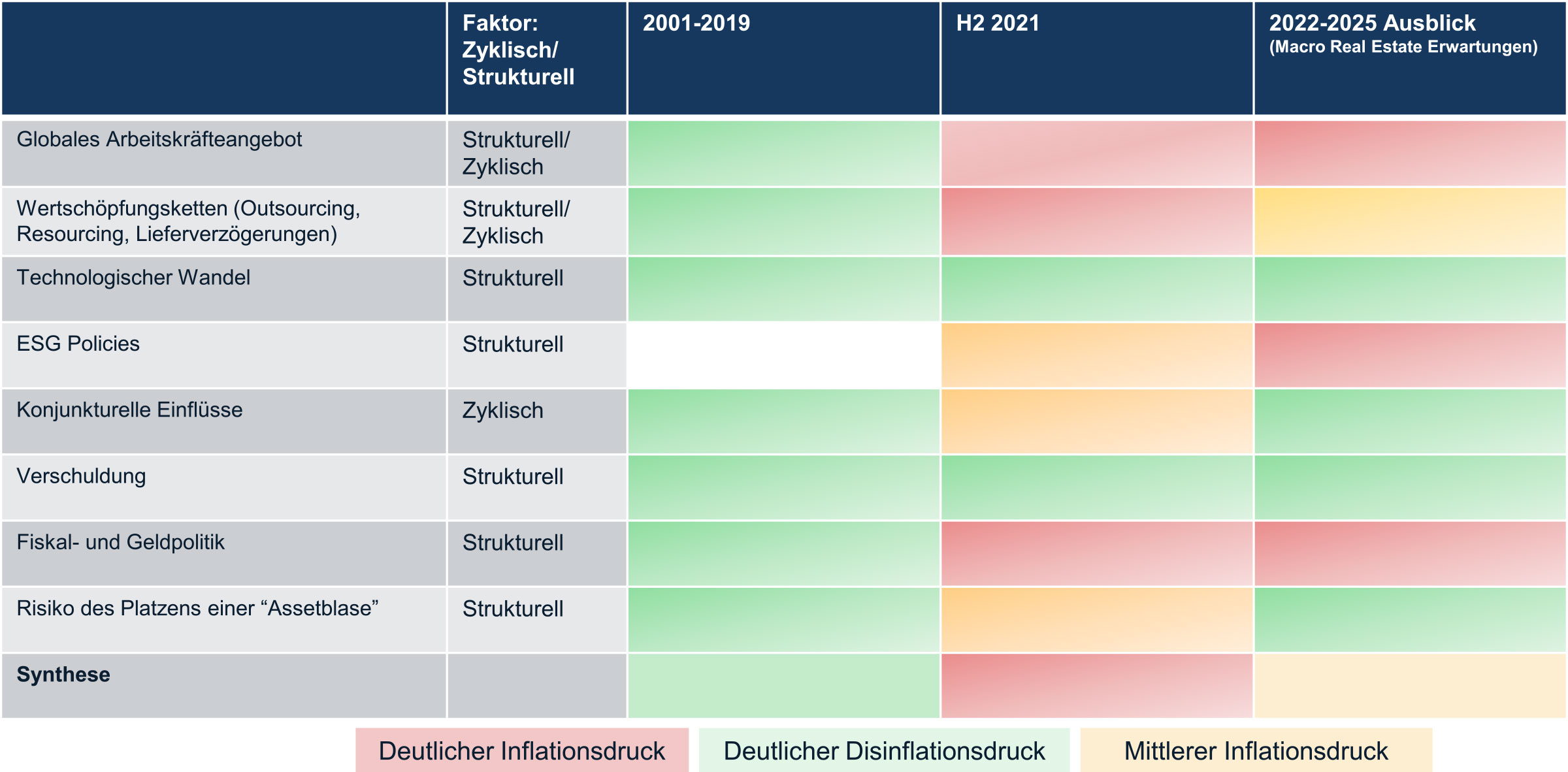
Macro Real Estate expects inflationary pressure to ease somewhat in 2022 and particularly in 2023, as companies respond to COVID-related supply delays and fiscal stimulus from the US loses strength. But inflation is likely to remain well above 2% in most industrialised countries over the next few years. Leaving aside the effects of COVID, we see the global deflationary forces, which over the past two decades were an important driver of strong real estate performance through steadily falling discount rates, giving way to structural inflationary trends (see Figure 2; a comprehensive analytical slide pack is available to Macro Real Estate clients).
Figure 2: Changes in global inflation drivers vs the 2001–2019 disinflation phase
Source: Macro Real Estate
Switzerland’s low public debt and its safe-haven role mean that inflationary pressure in Switzerland will be lower than in the EU or the US. But an end to the SNB’s negative interest rate also depends on the level of interest rates in the eurozone. Admittedly, the ECB is likely to keep trying to delay normalisation for political reasons. If inflation stays above target for an extended period, however, the ECB will have to raise rates. The SNB will be happy to follow suit, as it introduced negative rates only reluctantly, as a defensive strategy against the ECB’s excessively loose monetary policy.
Positioning the portfolio for net income growth potential
But what should real estate investors do now, especially when it comes to investing new money that has to be placed in the market at this point? Business as usual, i.e. investing capital directly or indirectly with a predominant share in Swiss core residential income-producing properties, does not strike us as a good strategy given the sharp fall in yields, even if one assumes that current inflation rates are only “transitory”. If, however, a macro environment even roughly along the lines anticipated by Macro Real Estate materialises over the next few years, there is an urgent need for action.
In an environment of very low net yields and of valuation and inflation risks, it is essential to ensure that the portfolio as a whole is also able to generate growth in net income. This is likely to be necessary to cushion higher discount rates.
Analysing the existing portfolio for “vulnerabilities”
The first step is to establish clearly which factors were actually responsible for past performance. A mere overview of exposures to sectors, regions or investment style (core, value-add) is not enough. What matters is to identify the drivers of performance. Passive contributions such as premium build-up and falling discount rates need to be set against active contributions such as income growth and manager alpha.
If falling discount rates alone were the biggest driver of returns in recent years, this factor will very probably turn against the investor in the near future.
The next step is to examine whether the exposure is able to generate income growth in the coming years as well, and how exposed it is to valuation risks. A residential portfolio in central locations with in-place rents, despite the high stability of those rents, is likely to underperform commercial assets with indexed rents significantly, since the link between in-place rents and the weighted average mortgage rate allows inflation to pass through only with a lag. In other words, a real estate portfolio with fixed cash flows offers no inflation protection and will suffer in an environment of higher interest rates.
A further question is how the portfolio is positioned for structural changes in society. A portfolio of older office or retail properties is also likely to perform worse than modern office exposures or logistics sites, to name just one example.
Making new investments and reallocations with discipline: the goal is net income growth
If the existing portfolio does not offer the desired resilience and net income potential, sales into the current strength of the market must be considered. The investment style (core, value-add, opportunistic) must also be critically reviewed. In our assessment, value-add and opportunistic strategies can even lower a portfolio’s risk profile in a higher-inflation scenario, as their interest rate risk is lower than that of core real estate.
New investments should therefore be made consistently and with discipline. This must happen regardless of national borders or sectors, and depends on the portfolio. In other words, it may mean increasing the share of commercial properties or development projects in Switzerland.
Recognising low foreign real estate allocations as untapped potential
In our assessment, most such opportunities for significantly higher net income growth lie outside Switzerland’s borders. Although some investors have made a start on international diversification, our observation is that most institutional investors struggle with the topic of foreign real estate. We see this as untapped potential.
However, foreign real estate investment also calls for a targeted approach. A core real estate fund that invests mainly in legacy office and retail properties and offers a dividend yield of only 2.9% (INREV Core Index average) in EUR is unlikely, after FX hedging costs, to add the desired value relative to Swiss real estate funds. Some core funds also carry latent write-down risks because of their “legacy assets” in office or retail.
Investments in funds that benefit from future structural trends, by contrast, do add value. Macro Real Estate sees strong potential for rising net income in a number of markets in the US and Europe. US and European life science real estate, senior living, medical offices in the EU, student housing and last-mile logistics, or the Singapore office market are just some of our “high-conviction calls”. We therefore recommend a research- and theme-based selection of vehicles, aligned with the existing Swiss portfolio.
The role Macro Real Estate can play
International real estate expertise is a fundamental prerequisite for selecting real estate funds in Europe, the US and Asia, or when investors invest directly in projects abroad with partners through joint ventures.
Macro Real Estate was founded to support investors and investment managers who lack the desired expertise in-house. From strategy workshops, market updates and portfolio analyses to fund selection, institutional-quality due diligence and onboarding, our many years of experience allow us to help partners master the Swiss and international investment universe, which is not always easy to navigate.
As our name suggests, we can base our recommendations on our clear-cut macroeconomic and international real estate market views, or easily and flexibly adapt them to clients’ house views or consensus expectations.
Zoltan Szelyes, 10 January 2022
Free for members
Read the full article
Our Thoughts are free for registered members. Sign up with your email, or log in if you already have an account.