
France's bond stress is now a Paris real estate problem

For most of the past fifteen years, investors in French real estate have priced their assets against a comfortable cushion: the prime yield on a Paris office sat well above what the French state paid to borrow for ten years. That cushion is now gone. According to ECB data, the French 10-year government bond (OAT) yielded 4.44% on average in September, up from 3.56% in December, while the Paris prime office yield stood at 4.50%, according to CBRE valuation data. The key question for anyone owning, financing or buying French property is therefore which of the two will move to restore the gap, and we believe it is more likely to be the property yield.
Which bond should French property be priced against?
A prime yield can be split into a risk-free rate and a risk premium, the latter compensating the investor for, for example, illiquidity, vacancy risk and the cost of running a building. In our MRE Score, which measures how far the spread between a prime yield and a 10-year government bond sits from its own five-year average, we use the German Bund as the risk-free benchmark for all euro area markets by default. This makes sense in normal times: rents are paid in euros, and cross-border capital tends to think of the Bund (or the swap curve) as the euro's risk-free rate.
These are not normal times for France, however. The energy shock from the Middle East conflict pushed inflation and yields up across Europe, and the ECB, citing the inflation pressures from the conflict, raised its deposit rate to 2.50% in September. France has added a fiscal shock of its own. The 2027 budget, which aims to cut the deficit to 5.0% of GDP from 5.4%, lacks a stable parliamentary majority, according to Investment House and MUFG, while public debt rose to more than 119% of GDP in the second quarter, according to Allianz Trade. Consequently, the gap between French and German 10-year yields widened from 72 bps in January to 97 bps in September on a monthly average basis (ECB data), and peaked at about 150 bps around the turn of the month, when the OAT briefly reached 4.99%. For a French insurer, a pension fund or an SCPI, the OAT is the alternative to buying a building. If the state pays almost as much as a prime office yields, the building has to offer more or become cheaper.
The cushion has disappeared
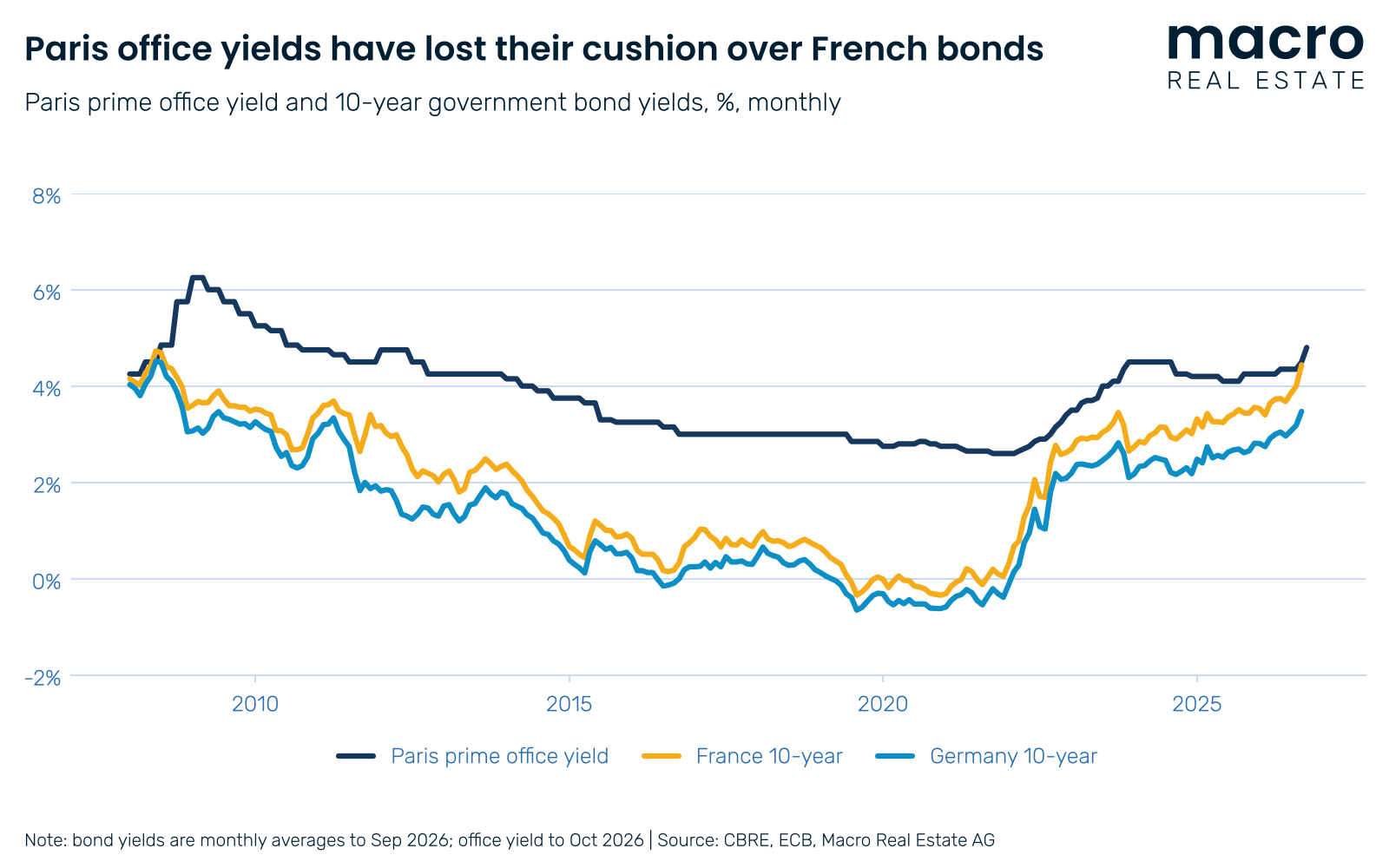
Figure 1 shows how unusual the current situation is. In September, the Paris prime office yield was only 6 bps above the monthly average OAT yield, against an average of approx. 108 bps over the past five years and the narrowest gap since mid-2008. Against the Bund, the spread was still 103 bps, which is tight but not alarming. CBRE moved the Paris prime office yield out by another 30 bps to 4.80% in October, but with the OAT trading at around 4.80% in mid-October, according to Investment House, the cushion has not been rebuilt. CBRE itself writes that the office risk premium has "disappeared, or even entered negative territory". And some clients we speak with are seeing their assets’ valuations, including in logistics, under pressure.
Indeed, the last time the gap was this thin, in 2008, it did not stay thin for long: Paris prime office yields rose from 4.50% in mid-2008 to 6.25% by January 2009, and the spread over the OAT widened to 265 bps. The trigger then was a global credit crisis, and we do not expect a repeat of that scale. But the episode is a reminder that the lack of a gap sooner or later raises property yields, although after the GFC, falling bond yields also helped reopen the gap, which made real estate pricing attractive again.
Figure 1: Paris office yields have lost their cushion over French bonds
Paris prime office yield and 10-year government bond yields, %, monthly (bond yields are monthly averages to Sep 2026; office yield to Oct 2026)
Source: CBRE, ECB, Macro Real Estate AG
It is not only offices
The repricing is broad. Figure 2 shows that Paris prime yields have moved out in nine of the ten sectors we track since December, most of it in the past three months. Urban logistics has moved out by 85 bps to 5.35% and big-box logistics by 60 bps to 5.50%, more than offices. High street retail has moved out by 50 bps to 5.00%, multifamily by 30 bps to 3.80% and hotels by 25 bps. Only retail parks, which already offered the highest yields, are unchanged at 5.75%. This is as of October: expect the Q4 valuations to reflect this if the Q3 valuations haven’t already.
Figure 2: Paris yields have moved out across sectors this year
Change in Paris prime yields, Dec 2025 to Oct 2026, bps

Source: CBRE, Macro Real Estate AG
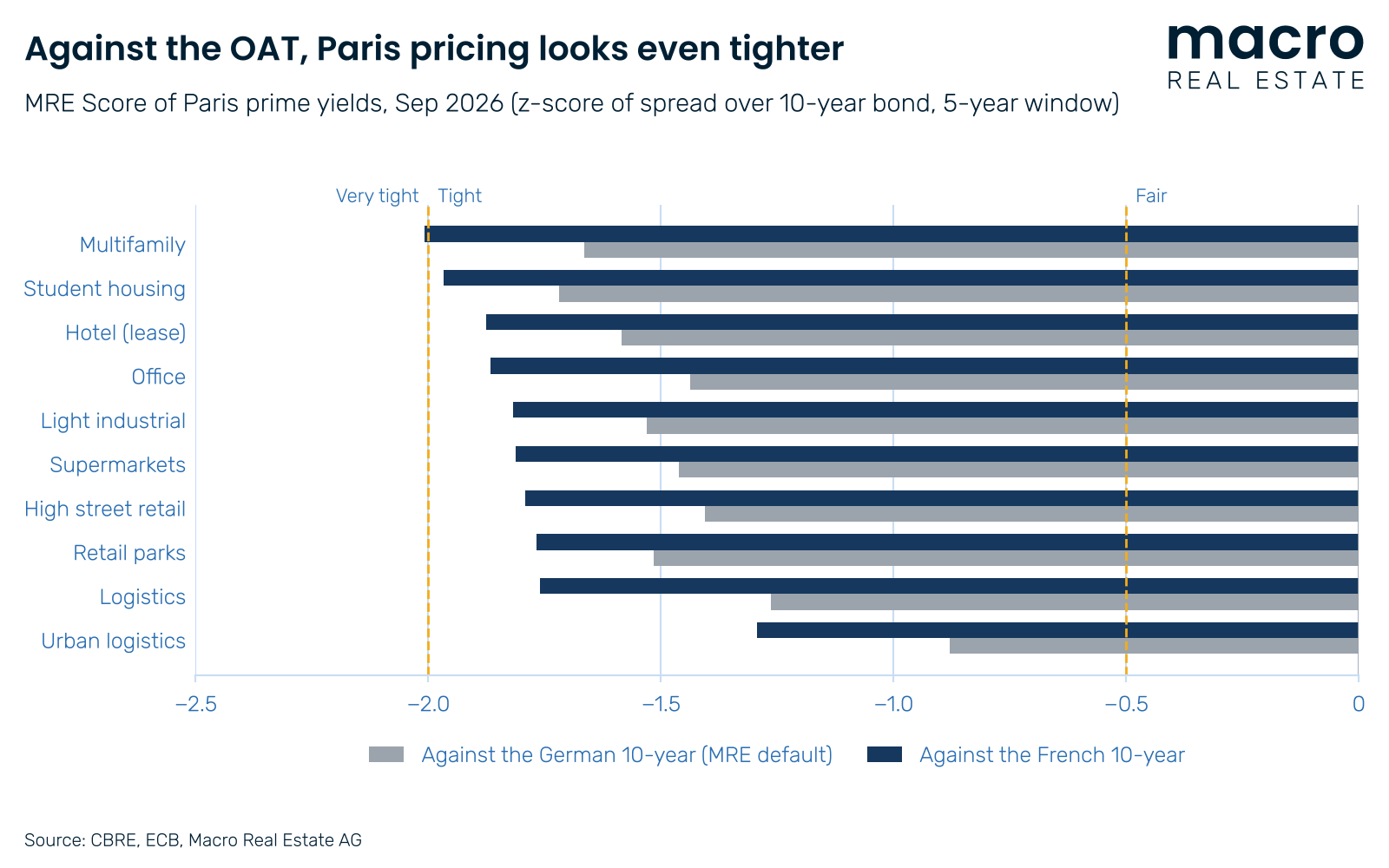
The MRE Score tells the same story in a different way (Figure 3). Measured against the Bund, every Paris sector we track is in "tight" territory, with scores between –0.9 and –1.7. Measured against the OAT, every sector is tighter still, and multifamily, at –2.0, has slipped just into "very tight" territory: its prime yield of 3.60% in September was 84 bps below the OAT. Student housing also yields less than the French state. It should be noted here that tight pricing against the Bund is a European phenomenon, not a French one: Munich prime offices, for comparison, score –1.9. What makes France special is that its own risk-free rate has moved, which stretches pricing further.
Figure 3: Against the OAT, Paris pricing looks even tighter
MRE Score of Paris prime yields, Sep 2026 (z-score of the spread over the 10-year bond relative to its five-year average; below –0.5 tight, below –2.0 very tight)
Source: CBRE, ECB, Macro Real Estate AG
The occupier market offers limited help, however: in logistics, CBRE reports take-up of approx. 2.3 million sqm in the first nine months, 26% below the five-year average and the lowest in ten years, although vacancy is a moderate 6.6%. Investment volumes look better than they are: CBRE records EUR 10.4bn invested in France over nine months, up 15% year on year, but the number of deals fell by 18%, and the sale of Capital 8 alone accounted for about a quarter of third-quarter volume. Buyers and sellers still disagree on price, and CBRE expects the market to search for its footing until 2027 or possibly 2028.
The counterargument deserves a hearing. Investors may simply look through the French sovereign spread, price Paris off the Bund and expect rental growth to close the gap. And if the budget passes and the presidential election in April 2027 calms the bond market, the OAT spread could narrow quickly.
We consider this the upside scenario rather than the base case. Italy offers a recent test: Milan prime offices yielded less than Italian 10-year bonds for most of 2022 and 2023, according to CBRE valuation data and ECB data, and the gap was closed partly by falling bond yields but also by the Milan prime yield rising from 2.90% in early 2022 to 4.65% by March 2024. As long as French institutions can earn more than 4.00% from their own government, it is likely that they will demand more from real estate.
If you’ve got an asset in the market or you are wondering how to approach the market in general, feel free to reach out.
Free for members
Read the full article
Our Thoughts are free for registered members. Sign up with your email, or log in if you already have an account.